Article
I Had One Game Idea. AI Gave Me Five More.
Building toys and a broken dishwasher showed me where AI can offer a useful next step and where my judgment still matters. Try one small, low risk problem if you want to see whether it helps.
Published
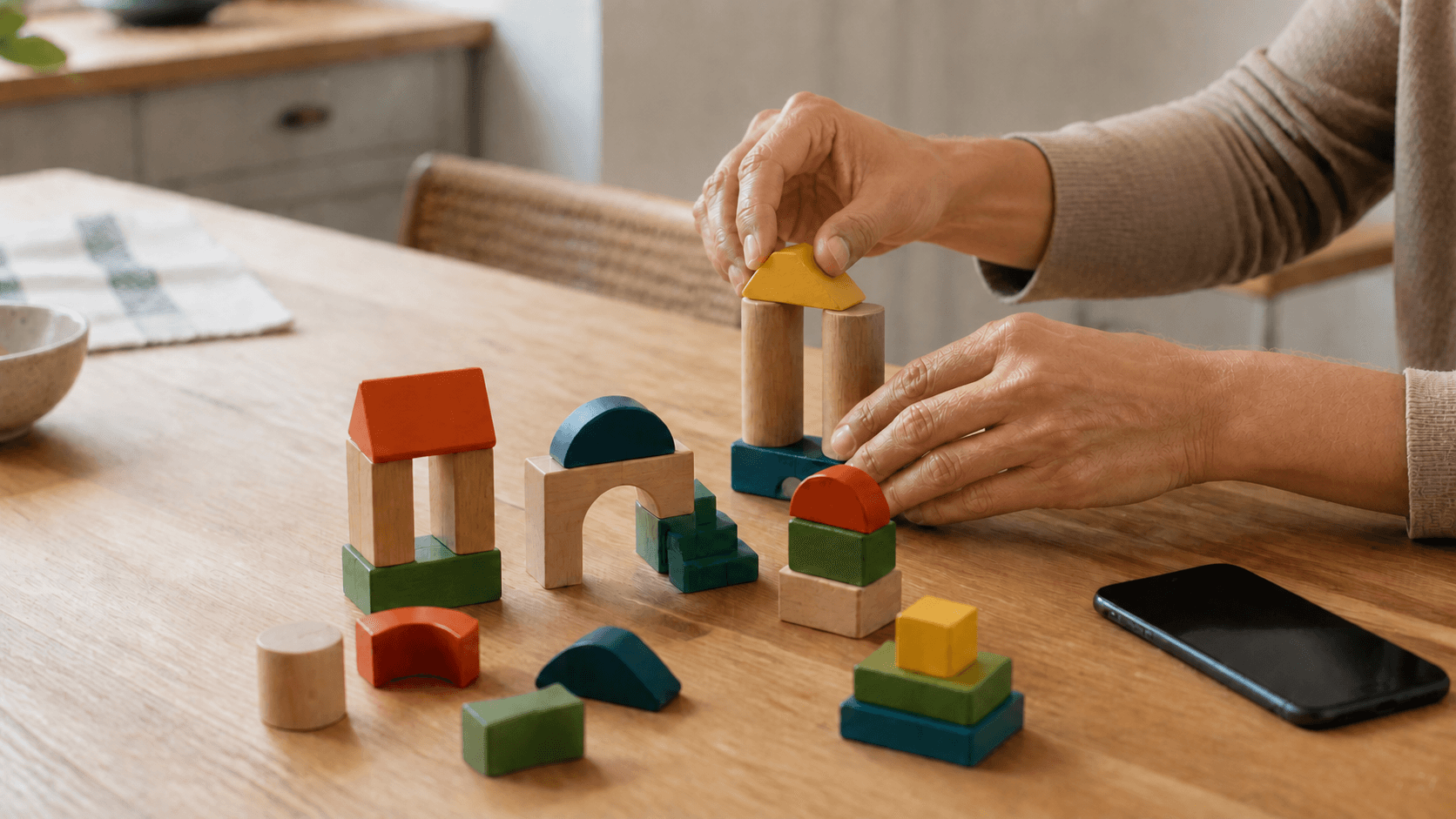
My son had a set of building toys, and I had one idea for a game we could play with them.
I took a picture of the toys and asked ChatGPT for more ideas. It gave me five suggestions.
When I shared that example, people told me they had mostly thought about AI as a work tool. I understood that reaction. I had not spent as much time thinking about how the same tool could affect me as a parent.
The suggestions were not the activity. They were a list of possibilities. A parent still has to decide whether any suggestion fits the child, the materials, and the moment.
That smaller kind of help is worth understanding.
The dishwasher was another ordinary experiment
During my conversation with Dr. Sheila White, I shared a second example. My dishwasher had stopped working for the third time. I used ChatGPT and YouTube to understand the error code, work through the next checks, and keep track of what happened.
The first attempt led to a new error, so I added that information to the next question. The added detail helped me decide what to check next. After working through the problem, I reported that the dishwasher worked again.
That is my account of one time I worked through the problem. It is not a repair guide, and it does not prove that an AI answer can replace a technician. The tool helped me move from a code I did not understand to a question I could check safely. If the problem had gone beyond that point, the responsible next step would have been a qualified professional.
A builder starts with the real problem
In both examples, the tool had something specific to work with.
For the toys, it had a picture of the objects and a request for game ideas. For the dishwasher, it had the error and a short account of what I had already tried.
I was not asking the tool to know my family or take responsibility for an appliance. I was using it to give me more options or one thing to check next.
That is the way I prefer to work. Try the tool on something real. Give it only the details it needs. Compare its answer with what is actually in front of you. Know when your own experience is enough and when you need someone with deeper experience.
The parenting example does not prove that AI makes someone a better parent. The dishwasher example does not prove that AI can diagnose every repair. They show two smaller things: AI helped me come up with ideas in one case and see what to check next in another.
Try one small use without giving away private information
Choose an ordinary, low risk object or situation where you want a few more ideas. Do not use a health, financial, electrical, repair, or other decision where a wrong answer could cause harm.
Share only the few details it needs. Keep faces, names, locations, passwords, company information, and private details attached to photos or files out of the request. Ask for three options, then review them yourself.
Did the response give you a useful starting point without asking you to hand over the decision?
If it did, you learned something about where the tool may fit. If it did not, stop there. That is enough for a first experiment.
Source conversation
This article draws from my appearance on Gifted with Dr. Sheila White: The Gradual Evolution of Artificial Intelligence, published November 27, 2023.