Article
AI Earns Its Keep When Scattered Project Information Becomes a Useful Brief
Marcus Turner explains how construction teams can turn scattered notes, logs, schedules, and updates into a useful brief with a repeatable AI method.
Published

Think about your last project review. How many places did the team check before anyone could say what changed? When records disagreed, did everyone know which record was official, or did someone rebuild the story in the room?
Construction teams are not usually short on information. They are short on a clean read of what matters now. That was the point I wanted to make in this session: the problem is not a shortage; it is that the information is scattered. When people have to rebuild the story repeatedly, decisions can slow down and follow-up can become less clear.
In the deck for this session, I put it plainly: "AI becomes useful the moment it turns many scattered sources into one useful brief."
That sentence shifts the conversation. A search-style answer may help once, but construction leaders usually need a brief that shows what changed, what is blocked, who owns the next move, and what deserves attention before the next meeting.
The useful brief is the real product
When I say "useful brief," I am not talking about a pretty summary that makes everybody feel informed for five minutes. I am talking about something operational. A useful brief helps a leader see decisions, open items, owner actions, top risks, and what changed since the last review.
That is why the session kept returning to recurring construction work instead of AI novelty. The same shape shows up again and again:
- an owner brief that pulls together meeting notes, schedule movement, and issue status;
- a readiness brief that compares look-ahead planning to what is actually ready;
- a delay-risk brief that reads requests for information (RFIs), procurement status, and coordination notes together;
- a lessons-learned brief that surfaces repeated root causes instead of letting them die in folders.
These are recurring places where teams piece the same story together manually. The problem is not only reading time. It is the variation created when people review the same material without a shared method.
The problem is the handoff of information. Teams do the work, but the information gets scattered across systems, inboxes, files, and personal habits. AI earns its keep when it reads across those records and gives the team something more usable than the pile it started with.
If one recurring handoff stands out, do not automate everything. Define one brief clearly enough to test the method and decide whether it deserves another run.
For a weekly owner brief, the records might include meeting notes, the latest schedule narrative, and the issue log. The output should be decisions, open items with owners, what changed since last week, and the one or two owner actions that matter before the next meeting.
For a readiness brief, the records might include the look-ahead plan, daily reports, and any open constraints. The output should answer a simple question: what is ready, what is not ready, and what is blocking the work that is supposed to happen next.
For a delay-risk brief, the records might include RFIs, procurement notes, and coordination comments. The output should name the activity at risk, the project record supporting that concern, and the next review point so the team can decide whether to intervene.
For a lessons-learned brief, the records might include closeout notes, field reports, and issue logs. The output should look for repeated causes, not just one-off complaints, so the next project can avoid the same miss.
A delay-risk brief you can test this week
Give it the current three-week look-ahead, the last owner-architect-contractor (OAC) notes, open RFI and submittal logs, procurement status, the constraint log, and the last seven days of daily reports. Then define the method:
Confirm the reporting period and current versions. Review near-term
activities first. Compare each activity with open constraints, RFIs,
submittals, procurement status, and reported field conditions.

Return:
Activity | Risk signal | Supporting source and date | Owner |
Needed action | Verification status

Separate confirmed facts from assumptions. Show conflicts between records.
Do not guess an approved date, decide whether the contract grants time or money, or trigger a notice.
Stop at a draft for the PM and scheduler to review.
That is enough structure to test whether the method improves the review. It is not permission to let a draft brief make a project decision.
The brief only works when the right information is available
When an AI output misses the mark, it is easy to blame the technology. Before doing that, ask whether the task had the right records, current versions, and dates.
In the session I said it directly: "Skills don't perform without the right context of information that's there."
In plain language, the AI needs the right records, current versions, and dates for the task.
The practical test is the four-question sequence I used in the session: What recurring task are we standardizing? What information does it need? What steps should it follow? What should the output look like? The second question is the one teams can rush past. A brief can be formatted perfectly and still be unhelpful if the records are stale, incomplete, or from the wrong period of work.
Before the AI starts, name the records it may use, which versions are current, what dates matter, and what is missing. If two records disagree, the brief should show that conflict instead of quietly choosing one. The goal is not to pretend AI has replaced review. The goal is to give the reviewer a clear starting point without hiding the gaps.
I made the same point for people who still work the old way, with handwritten notes, sketches, and paper pull-planning habits. That is not a reason to wait. If the process lives on paper, photograph it. Let AI create a first draft from it. Then review the result and tighten the method. A messy starting point is still a starting point. The bigger mistake is assuming the method is unusable until somebody buys a new platform.
Save the method so the team can see it
By a skill, I mean a saved set of instructions for recurring work: which records to read, in what order, what to compare, what to check twice, and how to organize the result.
A one-off chat can still be useful, but its steps often disappear. When the method is saved and visible, another person can inspect it, compare results, and improve it.
With a skill, the method is visible. In the session I said that with skills, "you can see exactly the workflow" and "modify the pieces that actually fit you."
That visibility matters because teams handle information differently. One may prioritize decisions and open constraints. Another may need field information translated for an owner or project executive. When the method is visible, the team can adapt it to the handoff it is trying to improve.
That is also why I do not think the most valuable skill is the flashiest one. The better question is whether it captures a recurring task involving project information clearly enough that someone else can run it, inspect it, and improve it. If it cannot do that, then the value is still trapped in one person's habits.
This is where AI starts looking less like a toy and more like a visible, repeatable way to handle project information. The point is not to admire a clever prompt. The point is to write down a method that survives past the moment one person figured it out.
Verify the project facts before anyone acts
A useful brief needs to show the difference between interpretation and project fact.
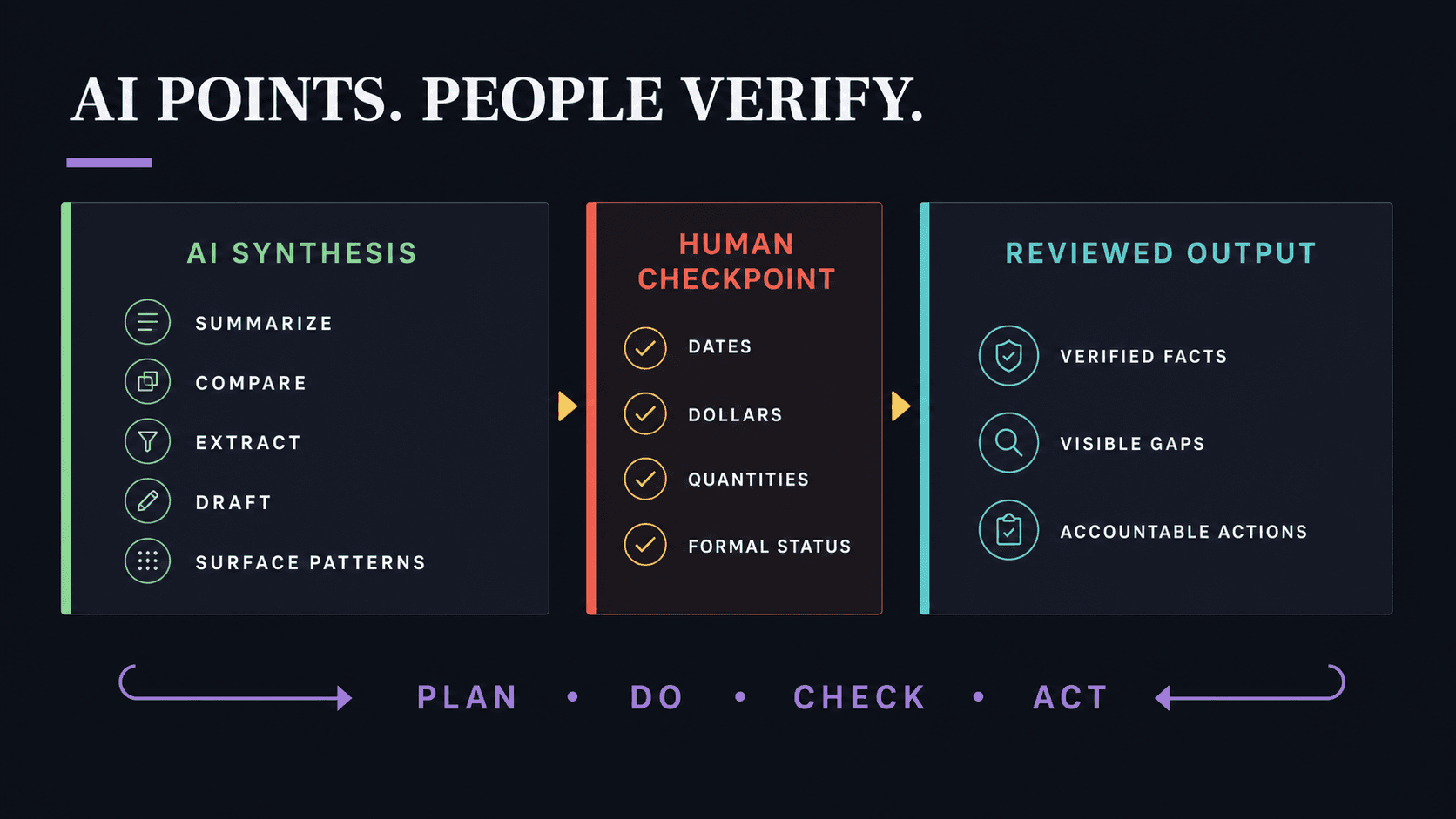
The skill can group written updates, highlight contradictions, and organize questions for the next review. When the brief reaches a committed date, an approved amount, a quantity, a calculation, or an official log entry, the accountable reviewer should return to the approved schedule, cost record, quantity source, or project log before acting. The brief brings the review together. It does not replace the official records.
That distinction should shape the output itself. Show which project record supports each important point. Make gaps and conflicts visible. Require a person to review the brief before a proposed action becomes a project decision. In this method, AI points, organizes, and proposes. People verify and decide.
Before anyone acts on the brief, check four things:
- committed dates against the current approved schedule or decision log;
- approved amounts against the cost system;
- quantities and formal status against the responsible log;
- every flagged conflict with the person accountable for resolving it.
When a brief misses the mark, do not ask whether AI sounded confident. Ask whether the reviewer can trace it to current records and see where judgment is still required. If not, inspect the records provided, the order in which they were reviewed, any exceptions, and the required human review before anyone relies on it.
The value compounds when teams share and refine the method
The most important part of the session was not the first version of any skill. It was the improvement loop after that.
I talked about Plan-Do-Check-Act because that mindset translates well here: plan the method, run it on real work, check what it missed, and update it before the next use. The gain is not only one better output. Every future use starts from a better version of the method.
That is why I also talked about teams sharing skills instead of keeping every method private. When people compare how they handle the same recurring task, they expose assumptions, exceptions, and better ways to structure the handoff. Over time, that becomes shared company knowledge. Not because everybody now has identical prompts, but because the group has a clearer way to produce a reliable brief from messy inputs.
Construction already understands this logic in other forms. We standardize handoffs. We build checklists. We capture lessons learned. We refine repeatable work because variation has a cost. Skills apply that same discipline to project information.
Here is a voluntary experiment: choose one brief your team already rebuilds. Before running it, agree on what a useful first draft should make easier to see. Define the records, review order, output, and required human review. Run it once, inspect what it missed, and then choose whether to refine it, defer it, or stop.
If it makes the project easier to review, keep improving the method. If it does not, investigate whether the problem is the records, the method, or the brief itself. Whether it earns another run is your team's decision.
If you test one recurring brief, I am always interested in comparing notes on what held up and what still needed work.