Article
AI Should Reduce Handoffs, Not Remove Experts
AI can help construction teams explore ideas sooner, but the right experts still need to review important work and remain responsible for final decisions.
Published
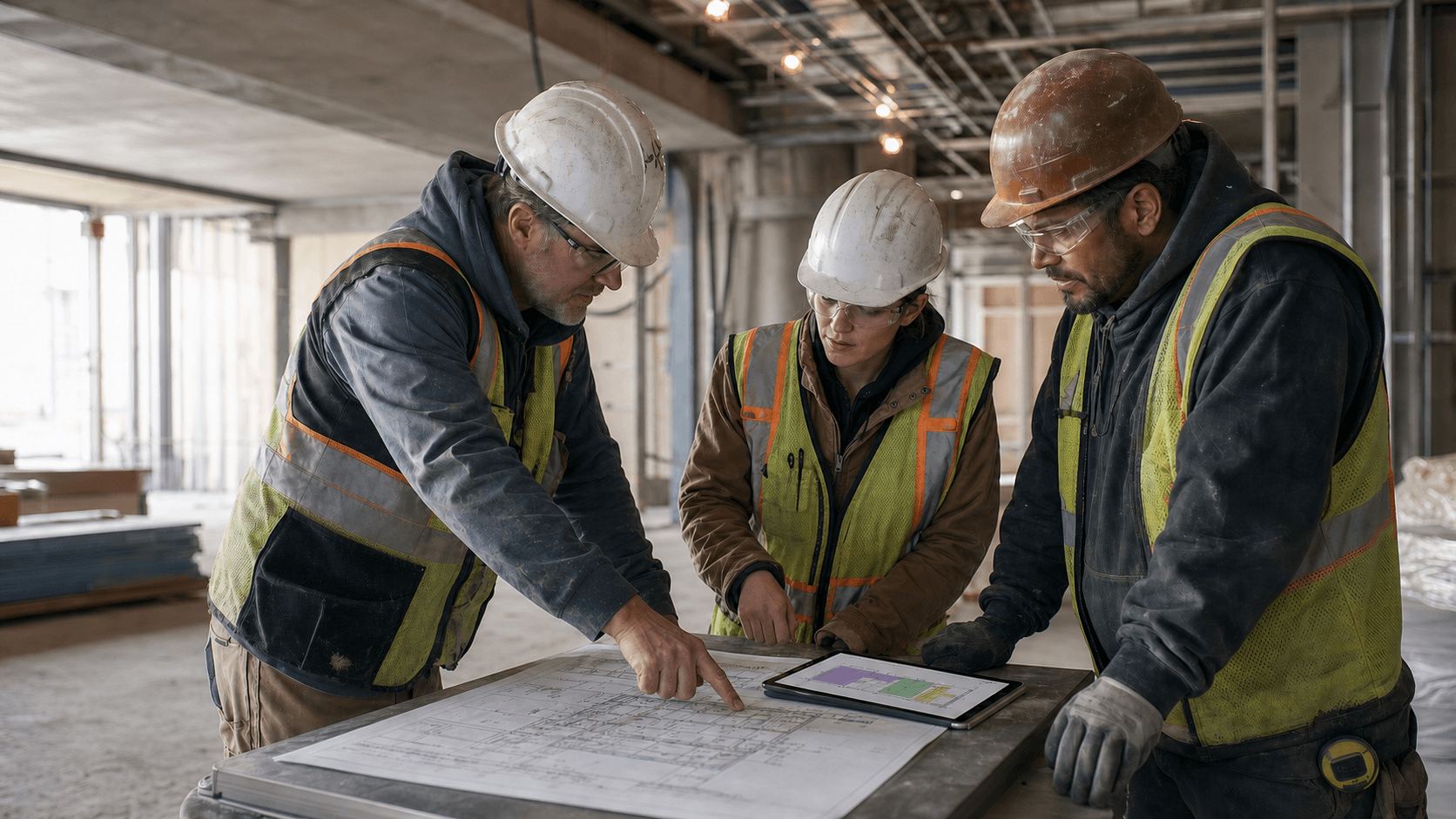
Imagine a project engineer uses AI to sketch a site setup and delivery option before the next coordination meeting. The draft routes delivery traffic, temporary access, material storage, and crane zones in a way that looks workable. It may be useful enough to start a conversation.
It is not yet a reliable site plan.
The draft may remove the wait for a first sketch. It does not show whether the site limits, order of trade work, owner requirements, and safety requirements have been reviewed. It does not tell the team who can judge the option or who owns the final decision.
This is the tension AI creates around traditional job roles. More people can participate in early work, but preparing a draft and having the experience to approve it are not the same thing.
If AI helped someone prepare work that once required an expert, does the expert disappear? Or did the checking, unusual problems, and responsibility simply move somewhere less visible?
The useful question is not whether AI can create a draft, plan, report, or analysis. It often can. The bigger question is whether the team can judge its quality, see what it missed, and make a sound decision from it.
That is where Lean changes the conversation. Lean is a way of improving work by creating more customer value with less wasted time, effort, and material. A handoff is simply the point where work moves from one person or team to another. The opportunity is not to act as if any person can replace any other person. It is to remove handoffs that only move information and get the right expert involved sooner.
Follow the work past the impressive first draft
An AI demonstration usually ends when the draft appears.
The real job continues.
Someone has to determine whether the project records were current. Someone has to recognize a wrong assumption. Someone has to decide whether the work meets the agreed requirements. Someone has to take responsibility when the answer becomes a decision that others will rely on.
Those are four different activities:
- prepare the draft;
- check whether it is correct and useful;
- decide what the organization will do;
- take responsibility for that decision.
AI can change how the first activity gets done. That does not automatically settle the other three.
Think about one draft made with AI moving through your organization now. Where did waiting actually disappear? Who now does the checking? If the result were wrong, who would notice before the next person used it?
If those questions do not have clear answers, the team does not yet have a dependable way to use AI. It has a faster way to produce drafts.
A faster task can create a slower project
Lean looks at whether work creates value and how smoothly it moves from a request to a decision, not only the speed of one step. The Lean Enterprise Institute describes Lean as creating needed value with fewer resources and less waste through repeated testing and improvement.
That means the team has to follow the work all the way to the accepted decision. Did AI only make the first draft faster, or did it make the whole project easier to run without hiding judgment?
Suppose one department uses AI to finish a task much faster. The draft then arrives with unspoken assumptions, no links back to the project records, and no named person authorized to approve it. Several people later in the process may have to rebuild how the answer was reached, check the records, and correct the draft before they can rely on it.
The producing department looks more efficient. The project may not be.
The Lean Construction Institute calls this Optimize the Whole. In plain language, judge a change by how it affects the entire project, not by how fast one person finishes one task. Applied to AI, that means looking beyond the time it took to create the first draft.
Ask what happened to:
- total time from request to accepted decision;
- work waiting for review;
- corrections and repeated explanations;
- unusual cases that remain unresolved;
- the workload placed on the people trained and experienced enough to check the work;
- the customer's ability to understand and act.
These are not arguments against AI. They are the things a team should measure to see whether AI helped the whole project or only made one step look faster while creating problems elsewhere.
Lean does not treat every handoff as waste
Some handoffs exist because information has been separated by systems and organizational habits. A person copies a status from one log into another, reformats the same update for a new audience, or waits for someone else to summarize records they could already access.
Those handoffs only move or reformat information. AI may help reduce the searching, copying, rewriting, and waiting around them.
Other handoffs exist because an expert needs to make a call.
A scheduler challenges broken logic. A superintendent compares a proposed sequence with field conditions. A designer evaluates whether an option meets the design intent and applicable requirements. A trade partner sees an installation limit that was invisible in the model. An owner decides whether the effect on daily operations is acceptable.
Removing the queue around that knowledge can improve the work. Removing the knowledge is a different decision.
Who prepares the early work can become more flexible. Who has the authority to make the decision still needs to be clear.
That distinction keeps the team from protecting every old departmental wall. It also keeps the organization from treating a believable draft as proof that the required skill and experience are now present everywhere.
Respect for people does not mean everyone can replace everyone else
Lean's Respect for People principle is sometimes reduced to good manners or avoiding disagreement. The Lean Construction Institute explains that it includes both how people treat each other and how the work is organized. People need conditions where they can do good work, raise problems early, and develop their skills.
AI can support that principle when it gives people more room to explore.
A project manager can test an idea before placing it in another department's queue. An early-career employee can compare alternatives and arrive at a review with better questions. A field leader can turn an observation into a rough idea for improving the work without waiting for someone else to rewrite it.
None of that requires pretending the participants now possess the same depth of judgment.
The expert's role may shift away from producing every first draft and toward work that has a bigger effect:
- defining what good looks like;
- showing the team how the work could fail;
- coaching others to recognize weak work;
- reviewing unusual decisions or decisions where being wrong could cause serious problems;
- designing repeatable checklists and review rules;
- resolving problems the normal process does not cover;
- improving the method after a breakdown.
This is not a guaranteed result of AI adoption. It is a design choice. If the organization removes routine work without setting aside enough reviewer time and making clear who decides, it may shorten one wait by creating another.
Respect for people should improve both the work and the worker. A tool that produces more drafts while hiding the extra checking work has not yet met that test.
Stop weak work before it moves to the next step
The Toyota Production System offers a useful way to think about this problem.
Toyota calls the idea jidoka, a Japanese term it translates as "automation with a human touch." In plain language, a machine or a person notices that something is wrong, stops the bad work before it reaches the next step, fixes the cause, and improves the process so the problem is less likely to happen again.
The AI version should not be:
AI prepares a draft. Someone glances at it. The draft gets used.
A stronger version is:
AI helps prepare the draft. Agreed review rules show that something is missing or wrong. A person with authority stops or rejects it. The right expert fixes the problem. The team improves the process.
A warning from AI is not enough. The team needs to define what counts as a problem, who responds, what that person should do, and how the team will learn from the failure.
Toyota later connected that principle to AI in its 2025 Global AI Accelerator announcement, describing the effort as rooted in jidoka and intended to help team members become more productive. That is an aim, not evidence of a measured result. The technology still sits inside a method that depends on people's skills and the habit of improving the work.
For construction office and planning work, a problem might be a date with no supporting record, a conflict between records, a missing agreed requirement, an assumption no one reviewed, or a recommendation AI was never allowed to make.
The goal is not to make AI sound less confident. The goal is to stop weak work before confidence carries it into a project decision.
Use four checkpoints instead of one departmental wall
Teams can decide where expert review belongs in several ways. They may keep an expert involved at every step, allow people to explore early ideas on their own, or increase review based on what could go wrong and how easy the decision would be to undo.
The four checkpoints below are one way to test that third option. They are not a universal rule.
1. Define the work
Before substantial work begins, identify the customer's problem, what a good result must include, the official project records, the main ways the work could go wrong, the rules it must follow, and the person authorized to make the final decision.
This is where a small amount of early expert involvement may prevent a large amount of correction later. The expert does not have to perform every task. The team does need to know which assumptions could make the later work unusable.
2. Let people explore early ideas across job roles
When the risk is low and the work is easy to undo, let people explore beyond their usual job descriptions.
Use AI to develop rough options, compare records, test an explanation, prepare questions, or turn an idea into something the team can see and discuss. Mark it as an early draft. Keep unanswered questions and unsupported assumptions visible.
The point is to expand participation without confusing a draft with an accepted answer.
3. Bring in the right expert before the decision becomes costly
Bring in the right expert before an assumption becomes expensive, difficult to undo, or important to the customer or project.
The review should match the decision. A preliminary communication draft does not need the same level of review as a schedule commitment, a cost decision, technical approval, a choice that could affect safety, or a contract decision.
This keeps the expert from having to review every small draft while making expert review a clear, required step where the work needs it.
Use three questions to decide how much review is needed:
- Is this an early test or a final commitment? An early test can allow more unanswered questions because it is easy to undo. A final commitment needs more proof, clear authority, and stronger review.
- Can the person preparing the draft tell whether it is correct and useful? Knowing how to produce an answer is not the same as recognizing a bad one.
- What happens if the answer is wrong? The greater the possible harm or cost, and the harder the decision is to undo, the earlier someone with the right skill and experience should review it.
4. Make the decision and learn
Before the draft is used, name the person who can approve it, send it back, or take it to someone with more authority. The team should write that rule down.
The Lean Construction Institute's Reliable Promises guidance explains what should happen before a person makes a commitment that others can plan around. That person should have the necessary skill or access to someone who does, estimate and reserve the time required, and commit freely. The team also needs an agreed description of what a successful result must include.
AI may help the person see limits, blocking conditions, and possible choices. It does not make the commitment for them.
After the decision, record what the process missed. Update the AI instructions, checklist, records it may use, review steps, or reasons to pause and ask for help. That is how the company learns from one AI test instead of repeating the same mistakes.
An occupied renovation shows the difference
Consider a project team planning work inside a building that must remain in use during construction.
The customer needs construction to move forward while essential building operations continue. The decision about the order and stages of work touches design, temporary access, field conditions, the order of scheduled work, coordination between trades, daily operations, and other project requirements.
In a traditional process, one group may produce a nearly finished plan before the next group sees it. Each review exposes another assumption, and the plan moves backward through the same chain.
Used well, AI could help the team explore earlier from shared information. It might organize known limits, draft several possible work sequences, list assumptions, compare where teams and work overlap, and identify questions that need an answer. Participants could challenge a rough option before anyone spends time making it look finished.
More people can help prepare the early options:
- the project manager can make an early sequence visible;
- the field lead can test whether the idea can actually be built;
- the scheduler can examine the planned order and relationships between tasks;
- design and trade experts can identify problems within their specialties;
- the owner's operations team can explain which disruptions are unacceptable.
The line around final decisions remains clear. People with the right training and experience still determine whether the technical, safety, schedule, cost, operational, and contract requirements have been met. The people responsible for the project decide whether the plan is ready for the next step.
This example does not prove that AI will shorten the review or improve the plan. It gives the team an idea to test: broader early exploration may reduce waiting for one group to finish before the next one begins, if the assumptions are visible, the right experts are involved, and everyone knows who can approve the plan.
If AI only produces a polished plan faster and sends it around the same broken review chain, the team automated the appearance of progress.
Review one handoff before changing the organization
Choose one draft made with AI that already moves, or appears ready to move, from one job role to another.
Follow it from the first project record to the final decision. Mark the handoffs that only move or reshape information. Mark the handoffs where someone adds expert judgment the next person needs. Name who can approve it, send it back, or take it to a higher decision-maker. Confirm that person has enough time to review it.
If a low-risk and easy-to-undo part of the work is suitable for a test, define which records AI may use, what AI may do, how much proof is required, who can approve the work, and what would cause the team to pause. Compare the whole path, not just the time AI took to prepare the first draft.
The review may support a more flexible dividing line between job roles. It may show that expert review needs to happen earlier. It may show that the process or project records need to become more consistent first, or that the manual method remains the right choice.
Each result gives the organization a clearer decision about where work can change and who must retain the final say.
AI can make a construction team more capable without pretending every person has the same judgment. A stronger way of working lets more people explore ideas, catches problems earlier, and brings in the right expertise before a draft becomes a decision that other people will rely on.
Fewer handoffs may improve how the work moves. Fewer experts is a different claim.
Do not confuse them.