- Type
- Livestream replay
- Primary guest
- With Michael Trampetti
What Does it Mean to Make Internet Access Inclusive
Watch the recording
Nearby Broadband Infrastructure Does Not Guarantee Access
By Brittanie Campbell-Turner
Published on Constructrr
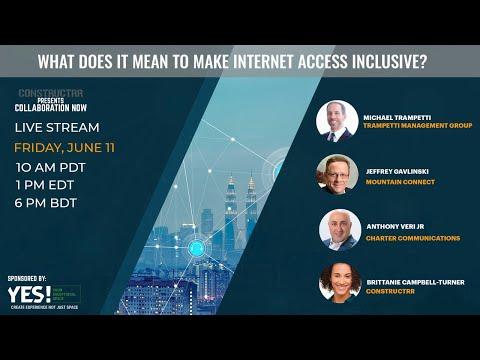
A fiber line can pass a neighborhood without giving the people who live there a useful internet connection. That was the central tension in my June 2021 Constructrr livestream with Michael Trampetti, Jeff Galwinski, and Anthony Veri Jr. I brought them together to ask how we could level the playing field for internet access.
Their answers did not stay at the level of new technology or broad public goals. They kept returning to the difference between infrastructure that reaches an area and service that reaches a household.
A nearby network can still miss the household
Michael Trampetti framed the problem through cost and expected return. Building infrastructure is expensive, so providers tend to extend service where the investment is likely to pay back. Michael’s point was not that the result was fair. It was that inclusion would not appear by itself when the business case was weak.
Anthony Veri Jr. showed how that could happen even in a major city. A provider might run fiber or cable through an area to support other network needs without extending strong service to the homes beside it. Anthony explained that the nearby equipment did not change the financial decision about serving those households.
Jeff Galwinski widened the picture. Jeff argued that internet access was not only a rural problem. Urban neighborhoods could have substantial infrastructure around them and still end up with weak service or very limited provider choice.
Together, those perspectives make access harder to judge from a map or headline. A community can look connected from a distance while the people who live there still have no useful path onto the network.
Coverage depends on who verifies the claim
Anthony Veri Jr. raised a problem that comes before a funding decision. “We’re not hearing enough from them,” he said, explaining that people with weak internet access can be hard to reach through an online survey. Anthony also questioned reports submitted by providers when those reports were not checked against what households actually received.
Jeff Galwinski explained how partial service inside a large census block could hide the people still left out. If the entire block was marked as served because a small part had access, the label could make the remaining need less visible.
Across the panel, the same gap kept appearing. One organization reported coverage, another directed funding, and local officials handled approvals. If no one checked those steps against what households actually received, an area could stay labeled as served while the problem remained.
The issue was less about a new bandwidth target and more about who did the checking. Coverage reports, funding decisions, and local approvals had to connect to the same household-level result.
Local progress needs someone who can keep it moving
Jeff Galwinski was direct that one model would not fit every community. Jeff described the need for local champions who could keep educating decision-makers even as public officials changed.
Michael Trampetti shared a rollout example in which former officials and education tours helped explain why added infrastructure was needed. Michael’s example showed that local approval was not only a technical or permit task. Someone had to translate the need, answer questions, and keep the conversation moving.
Anthony Veri Jr. pointed to small wireless providers rooted in underserved communities as another practical path, especially when larger providers did not see a strong return. Anthony’s point was that local providers already serving a community should not be overlooked.
If this pattern is familiar in a community you serve, a useful starting point is an area where reported coverage and resident experience do not match. Compare the provider record with what households can actually use, make room for people who cannot respond online, and name the person who will carry the discrepancy into the next funding or planning conversation. That will not solve the whole access gap. It can make the hidden part specific enough for a real decision.
Inclusive internet access is not complete when infrastructure reaches the area. It becomes real when the service reaches the people who live there and when someone is responsible for checking that it did.
Recording information
People, topics, and original sources for this recording and article.
At a glance
- Original source date
- People
- Michael Trampetti, Telecom operations and management consultant
- Jeff Galwinski, broadband industry-relations and conference executive
- Anthony Veri Jr., IoT and wireless strategy manager