- Type
- Livestream replay
- Primary guest
- With Michael Lake
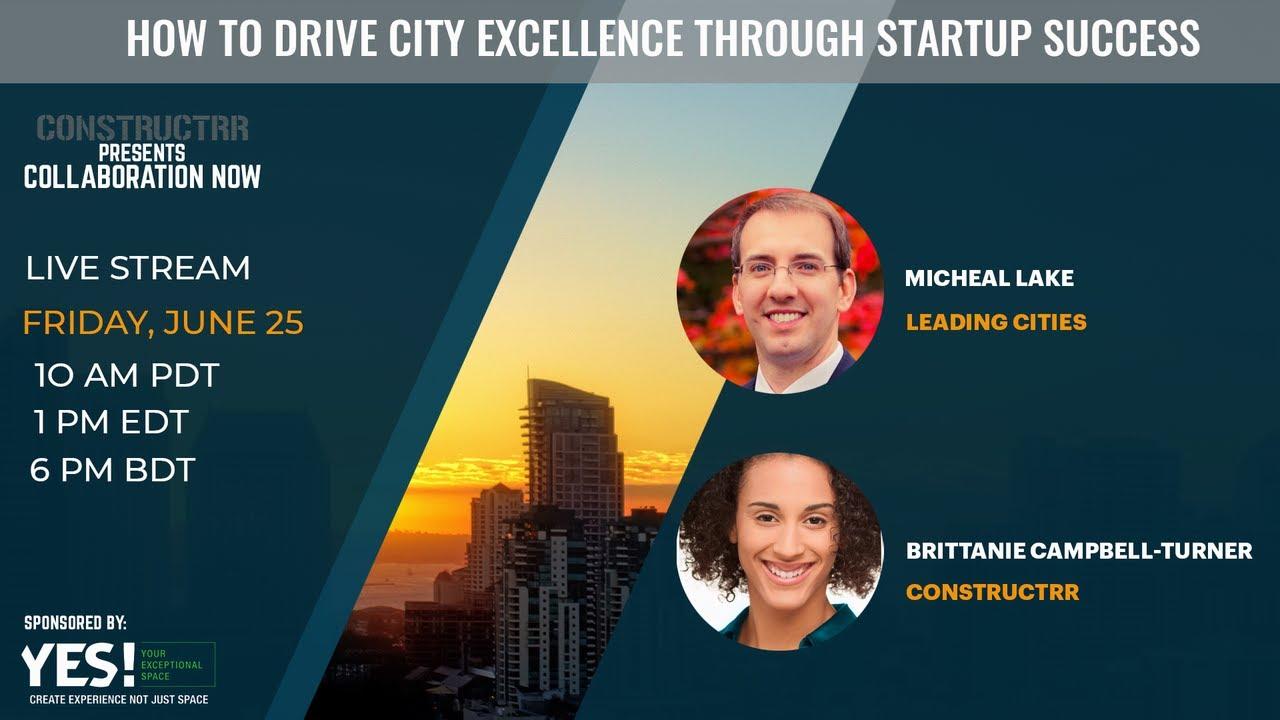
How to Drive City Excellence Through Startup Success
Watch the recording
This recording cannot be played here. Open the original source below to watch.
In 2021, Michael Lake Framed City Innovation as a Confidence Problem
By Brittanie Campbell-Turner
Published on Constructrr
In a June 2021 Constructrr livestream, Michael Lake described the divide between cities and startups as a human decision problem as well as a procurement problem. A public official could be responsible for the civic result and for the personal consequences of supporting a new solution that failed.
Michael summarized the response as “reducing the risk associated with innovating for a city and simultaneously increasing the confidence” of the city leader. His sourcing and pilot examples came from the 2021 AcceliCITY program, where broader outreach, expert review, and a paid pilot were meant to support that confidence.
Personal risk helped explain the hesitation
Michael Lake said a city leader could face blame if an innovative solution malfunctioned. He did not describe hesitation as proof that officials disliked technology. He described a decision maker weighing city risk, personal responsibility, and a solution without a long public track record.
That framing made confidence part of the adoption process. The city still needed evidence and judgment. Confidence did not replace the city's need for either one.
Broad sourcing was followed by expert review
Michael described AcceliCITY as a response to the gap between cities and startups. In 2021, the program sourced solutions beyond the usual applicants, then used a network of experts to evaluate them before a city made its own choice.
He said the review was reassuring when multiple experts asked difficult questions and reached a similar conclusion. The city still retained final authority over the decision. The outside review informed the decision without taking ownership of it.
The paid pilot was a bounded commitment
The livestream described startups competing for paid pilot projects. Michael Lake also explained why he believed a pilot should be paid, especially when a startup was already carrying a long public-sector sales cycle.
A pilot in this 2021 model was not full adoption and it was not a free demonstration. It was a limited city decision with money, responsibilities, and a real problem attached.
Write the pilot decision before asking for innovation
For one city challenge, prepare a short decision brief that names the civic risk, the personal responsibility carried by the official, the evidence reviewers will examine, the boundary of the paid pilot, and the city role that keeps final authority. Use that brief to decide whether the next step is justified.
Expert vetting could inform the choice, but it could not remove the city's risk or make one accelerator model right for every community. In Michael's 2021 program, the goal was a more informed and clearly bounded public decision.
Recording information
People, topics, and original sources for this recording and article.
At a glance
- Original source date
- People
- Michael Lake, Leading Cities representative and AcceliCITY program leader; exact title not stated in transcript
Related links
How to Drive City Excellence through Startup Success
Related video
Open related mediaHow to Drive City Excellence through Startup Success
Related video
Open related media