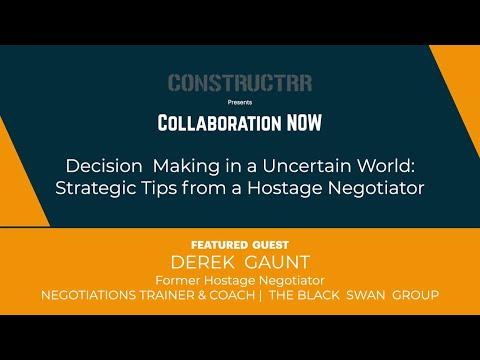
- Type
- Livestream replay
- Primary guest
- With Derek Gaunt
Collaboration NOW: Decision Making in an Uncertain World
Watch the recording
Tactical Empathy Comes Before the Ask
By Brittanie Campbell-Turner
Published on Constructrr
In December 2020, I asked Derek Gaunt how people could communicate and make decisions during a period of uncertainty and distance. Derek put the sequence plainly: “It's always tactical empathy first” and “whatever your ask is comes last.”
That sequence did not require giving up the objective. It required understanding how the request could affect the other person before presenting it.
Understand the other person's view before advancing yours
Derek Gaunt said the mindset began with recognizing, “It's not about you”. He asked speakers to consider the other person's view of the situation, how the request would affect them, and what it could change in their world.
In his framework, articulating that view first could reduce resistance when the conversation eventually reached the speaker's goal. This was Derek's 2020 teaching, not a guarantee that empathy will produce agreement.
Listening is information work
Derek Gaunt called his approach aggressive listening. He described listening for the other person's worldview, emotion, logic, and frame of reference instead of listening only long enough to prepare a rebuttal.
That made tactical empathy more than a polite opening. The speaker needed information that had not yet surfaced, and listening was how the conversation made that information available.
A safe no can protect autonomy
Derek Gaunt also recommended turning some yes-oriented questions into no-oriented questions. His reason was that people could feel driven toward a yes and become defensive. A question that allowed a no could protect autonomy and create room for a response.
His purpose was to avoid driving the other person toward a yes. Derek said the no-oriented form protected the other person's autonomy. In his example, allowing a no could make agreement more likely.
Before one difficult conversation, write the request you plan to make. Then write one sentence that names the other person's likely concern and one question that gives them room to disagree or correct your understanding. Use the response to learn before returning to the request.
Curiosity keeps the response from arriving too early
Derek Gaunt described labels as tentative observations that the other person could confirm or correct. He encouraged people to assume they had something to learn and ask what motivated a statement or question that did not make sense.
Derek said it directly: “You can't be mad and curious at the same time.” In the 2020 discussion, curiosity was a way to pause the automatic rebuttal and keep gathering information.
Anger is a reason to investigate the exchange
Derek Gaunt said a blowup could be an attempt to manipulate, a sign that someone did not feel heard, or a response to pressure on the other side. He advised looking for the motivation instead of reacting only to the volume.
He also warned that ignoring the negative emotion did not make it disappear. His approach was to stay with the issue, ask what caused the response, and clear enough of the negative emotion for rational discussion to resume.
Derek defined a difficult conversation as one in which one person's want or need depended on the other person. He expected negative emotion in that setting and argued for addressing it before returning to the objective.
Keep the sequence honest
The ask comes last because the other person's view is part of the information needed for a responsible decision. Listen for it, test your understanding, protect the person's ability to disagree, and investigate what has not yet been said.
Tactical empathy cannot guarantee agreement. It can keep the speaker from asking for a decision before the conversation has made room for the people who must live with it.
Recording information
People, topics, and original sources for this recording and article.
At a glance
- Original source date
- People
- Derek Gaunt, Negotiations coach and trainer; former hostage-negotiation team member and leader; 29-year law-enforcement veteran; leadership author